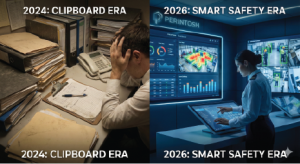
You might have a file labelled “Safety Committee” on your shelf, but does it function in real life? If you spot any of these 5 red flags in your workplace, it’s time to intervene.
1. The “Ghost Town” Meeting (Lack of Quorum)
The Scenario: You scheduled the quarterly meeting. But on the day of, the Production Manager is “too busy,” the HR rep is on urgent leave, and the worker reps are covering shifts. You end up having a quick chat with two people and call it a meeting.
⚠️ The Regulation Check: According to Regulation 21 of the SHC Regulations 1996, a meeting is only valid if you have a quorum (Chairman/Secretary + at least half of the other members). The Risk: If a DOSH (JKKP) officer audits your minutes and sees the same 3 people signing off for a 12-person committee, those meetings are void. You are legally non-compliant. The Fix: Set the dates a year in advance. If you can’t get a quorum, reschedule immediately. Don’t fake it.
2. The “Copy-Paste” Minutes
The Scenario: We’ve all seen this. You look at the meeting minutes from January, April, and July, and they are identical.
- Agenda Item 1: Accidents? None.
- Agenda Item 2: Hazards? None.
- Agenda Item 3: Other Business? No.
The Regulation Check: Regulation 11 states the committee must assist in the development of safety and health rules and review the effectiveness of safety programs. The Risk: In a real workplace, conditions change daily. “Copy-paste” minutes prove that the committee isn’t actually looking at the workplace. If an accident happens, these empty minutes will be used as evidence that the company was negligent. The Fix: Challenge the “No.” If there are no accidents, look for “Near Misses.” If there are no near misses, review the HIRARC document. There is always something to discuss.
3. The “Tourist” Inspection
The Scenario: The committee does the mandatory workplace inspection, but they look like tourists strolling through a mall. They walk the main hallway, wave at the staff, and go back to the air-conditioned office. No checklists, no looking behind machines, no checking fire extinguishers.
The Regulation Check: Regulation 12 requires the committee to inspect the place of work at least once every 3 months. The Risk: This is “surface compliance.” You are missing the hidden hazards—frayed wires, blocked exits, expired chemicals—that cause the real fires and fines. The Fix: Assign zones. Give the Office Rep the warehouse zone, and the Warehouse Rep the office zone. Fresh eyes catch more hazards!
4. The “Suggestion Box” is Full of Cobwebs
The Scenario: An employee sees a forklift driving too fast. They want to report it, but they don’t know who their Safety Representative is. Or worse, they reported it 6 months ago, and nobody ever got back to them.
The Regulation Check: Regulation 17 requires the committee to investigate any complaint related to unsafe practices or conditions. The Risk: If workers feel ignored, they stop reporting. This destroys your Safety Culture. Under OSHA 1994 (Section 24), employees have a duty to cooperate, but employers must create the channel for that cooperation. The Fix: Post the photos and names of Committee Members on the notice board. Make “Reviewing Complaints” a permanent agenda item.
5. The “One-Man Show” (The SHO/Coordinator Trap)
The Scenario: During the meeting, the Safety and Health Officer (SHO) or the OSH Coordinator does 100% of the talking. The Chairman (usually the Employer) checks their phone, and the representatives just nod until the donuts are served.
The Regulation Check: The law calls it a Committee for a reason. Regulation 5 outlines the composition to ensure joint responsibility. The Risk: This leads to burnout for the Safety Officer. Plus, under the OSHA 2022 Amendment, top management (The Chairman) can be held personally liable for failures. Ignorance is no longer a defense. The Fix: Rotate the role of “Inspector” or “Presenter.” Make the Production Manager present the accident stats. Make the Worker Rep present the hazard report. Share the load!
BONUS: The “Secret Weapon” – Where Does the OSH Coordinator Fit In?
If you are an SME with 5 to 39 employees, you might be thinking, “I don’t have 40 staff, so I don’t need a committee, right?” Wrong. You might not need a formal committee under Section 30, but under the new Section 29A of OSHA (Amendment) 2022, if you have 5 or more employees, you must appoint an Occupational Safety and Health Coordinator (OSH-C).
But here is the “Sweet Spot” for medium-sized companies (40+ employees) who do need a committee: Your OSH Coordinator is likely the best person to be the Committee Secretary.
Instead of forcing a random admin clerk to take minutes they don’t understand, appoint your trained OSH Coordinator as the Secretary. They are trained to:
- Identify hazards (HIRARC).
- Manage DOSH (JKKP) reporting.
- Bridge the gap between the “Boss” (Chairman) and the workers.
- Result: Your committee stops being a “paper tiger” and starts being an engine for change.
The Solution: How to Wake Up Your Committee (Today)
Reviving a dead committee doesn’t require a massive budget. It requires a shift in mindset. Here is your 3-step resuscitation plan:
1. Train Them (Seriously)
Most committee members are “sleeping” because they are bored or confused. They don’t know what a “safe system of work” looks like.
- Action: Send your committee for Effective Safety & Health Committee Training. When they understand how to inspect and what to look for, they become engaged detectives rather than passive tourists.
2. Rotate the Roles
Don’t let the Safety Officer do all the talking.
- Action: In your next meeting, assign the “Incident Review” to a worker representative. Assign the “Housekeeping Report” to a manager. When people have to speak, they prepare. When they prepare, they care.
3. Give Them “Stop Work” Authority
Nothing kills enthusiasm faster than a committee that has no teeth.
- Action: Create a policy that allows Committee Members to temporarily stop unsafe work without fear of punishment. When workers see the committee actually keeping them safe, trust skyrockets.

Conclusion: Compliance is Cheaper than an Accident
Let’s look at the bottom line. A “sleeping” committee saves you a few hours of meeting time, but it exposes you to:
- The Law: Fines up to RM50,000 or jail time (under the new OSHA amendments).
- The Business: The massive cost of a workplace accident (medical bills, downtime, reputation damage).
An active, awake Safety & Health Committee is your cheapest insurance policy. It identifies the cracks in your armor before an accident happens.
Don’t wait for the DOSH audit to wake you up.
Ready to Transform Your Safety Team?
At Perintosh, we don’t just teach you the law; we teach you how to apply it in the real world.
- Need to train your OSH Coordinator? Check out our.
- Need to revive your Committee? Book our hands-on Safety & OSH Coordinator Competency Course Health Committee Training.
Talk2US now. WhatsApp our team directly at 0137259122 or email info@perintosh.com
Download your OSH Coordinator pack here: OSHC2025.pdf